David Bray Receives the 2025 Laney Graduate School Distinguished Alumni Award
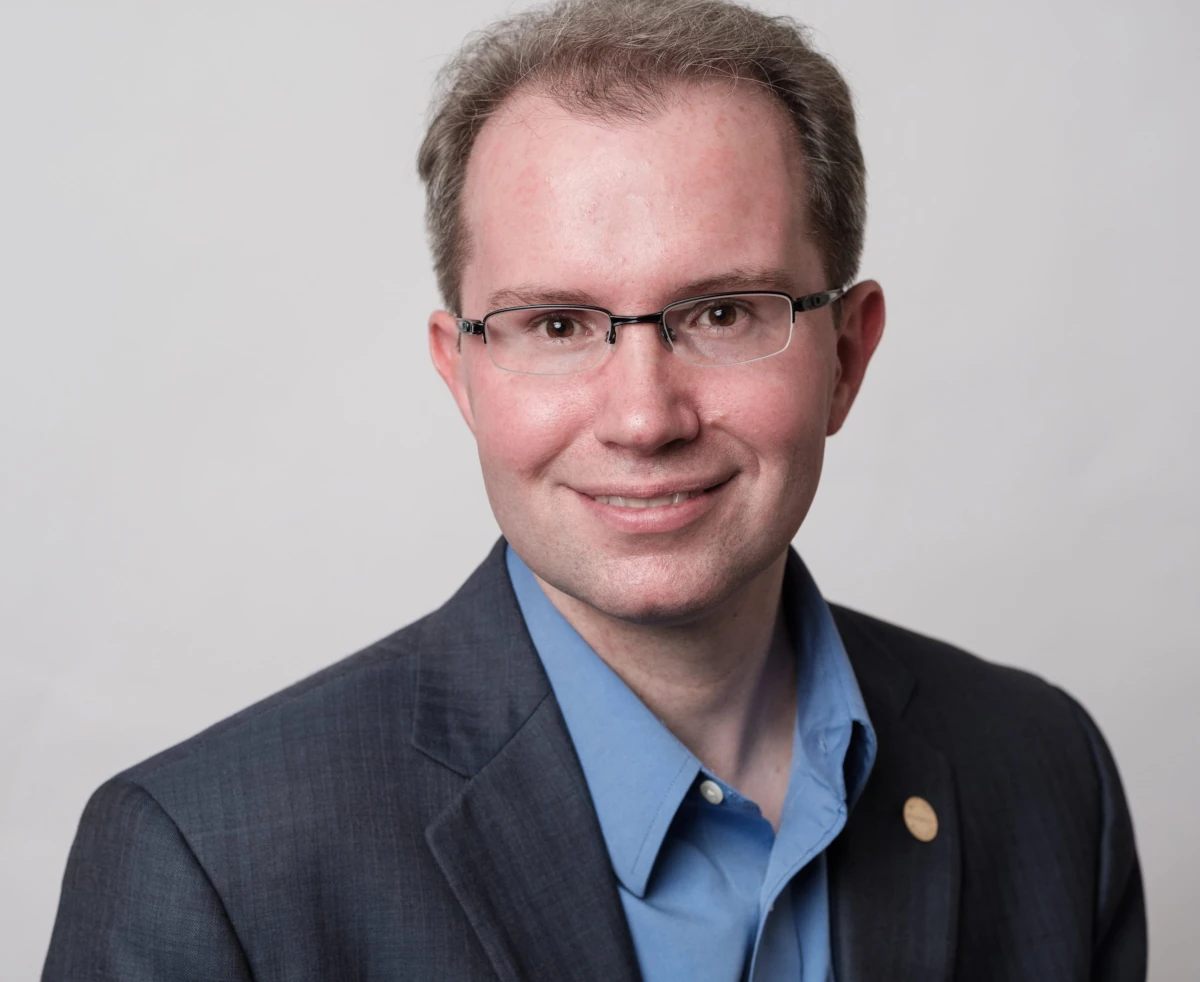
Emory alum David Bray 01C 04PH 08PhD has always been interested in answering big questions.
“My father was a Methodist minister, and when I was a teenager, I wanted to figure out who my dad worked for,” said Bray. “So, I started creating computer simulations of natural phenomena.”
Through science fairs, Bray's talent caught the attention of the U.S. government and at age 15 he was invited to join a team of scientists at a high-energy physics facility studying subatomic particles including quarks, some of the smallest building blocks of matter. That same year he joined oceanographer Robert Ballard, PhD, best known for his discovery of the Titanic shipwreck, on a research project with the U.S. Navy in the Sea of Cortez. By 17, he tackled interesting work involving classified satellites, computer simulations, and novel use of imagery of the Earth.
“There are a lot of interesting outcomes if you’re willing to ask ‘why?’” said Bray, the recipient of the 2025 Laney Graduate School Distinguished Alumni Award.
As an undergraduate at Emory, he continued computer modeling and began volunteering for multiple Habitat for Humanity International missions to the Philippines, Romania, Nepal, Ghana, and South Korea. In 2000, he joined the CDC’s Bioterrorism Preparedness Response Program, later responding to the events of 9/11, anthrax, West Niles virus, severe acute respiratory syndrome, and monkeypox during a turbulent five-year span.
Bray received his MSPH in Bioinformatics from Rollins School of Public Health and later enrolled in the James T. Laney School of Graduate Studies to obtain a business PhD focused on effective decision-making in turbulent environments, shaped by his experiences in bioterrorism response. After completing post-docs at both Harvard and MIT, Bray then volunteered to be on the ground in Afghanistan to “think differently” about both military and humanitarian missions.
“Dr. Bray has become one of the most influential technology leaders of our generation,” wrote his nominators. “His commitment to public service is extraordinary. From responding to 9/11, the 2001 bioterrorism threats, and SARS in 2003 to time on the ground in Afghanistan with military and humanitarian assistance missions after he completed his PhD, he has consistently put his expertise to work for the greater good.”
In the years that followed, Bray continued to thrive in leadership roles across government, often earning bipartisan support. His expertise covers a broad range of areas, including modernizing IT systems, enhancing operational efficiency, advancing next-generation cybersecurity, and fostering trust in AI and the digital economy. In 2016, Bray was named one of 24 Americans changing the world by Business Insider. At the core of his work are the insights gained during his PhD, particularly around effective decision-making and empowering teams to serve as positive agents of change.
“During my time with the Laney Graduate School, Professors Benn Konsynski and Holli Semetko were especially inspirational,” said Bray. “Benn was willing to think differently about the future of business and technology and did so via constructive realist approaches. Holli was also open to the idea that technology would impact both the future of geopolitics and how effective governments would be in the future.”
“Bray embodies the ideal of a Laney Graduate School alumnus; leveraging his education to make substantial contributions to both his field and society,” wrote his nominating committee.
Nowadays, Bray focuses his efforts on serving as Distinguished Chair of the Accelerator at the Stimson Center as well as Principal and CEO of LeadDoAdapt (LDA) Ventures, where he advises organizations navigating global turbulence through strategy, emerging technologies, and resilient operations. His work includes incubating new tech and policy initiatives, helping existing companies navigate the changing world, and provides executive consulting, including work associated with a $1B venture focused on secure infrastructure in space, air, and data.
Bray’s connection to Emory remains deeply personal. Bray met his wife, a two-time graduate of Emory’s Nell Hodgson Woodruff School of Nursing, through shared Emory connections. They were married in a ceremony on Emory’s campus by the Rev. Dr. Susan Henry-Crowe. Afterwards, they marked the occasion by inviting their guests to help plant a winter king hawthorn tree, known for its beautiful white spring flowers, attractive fall foliage and vibrant red berries in winter, that still stands beside Cannon Chapel.
“Laney Graduate School and the entirety of Emory provided opportunities for me to prove empirically that both technologies and turbulent environments require us to think differently about leadership,” said Bray. “I’m immensely thankful to inform new ways of leading amid turbulence, as well as the freedom to explore the important questions so we can better navigate the future together.”