Laney Graduate School Welcomes Kevin M. Bonney, PhD as Assistant Dean of Teaching Innovation
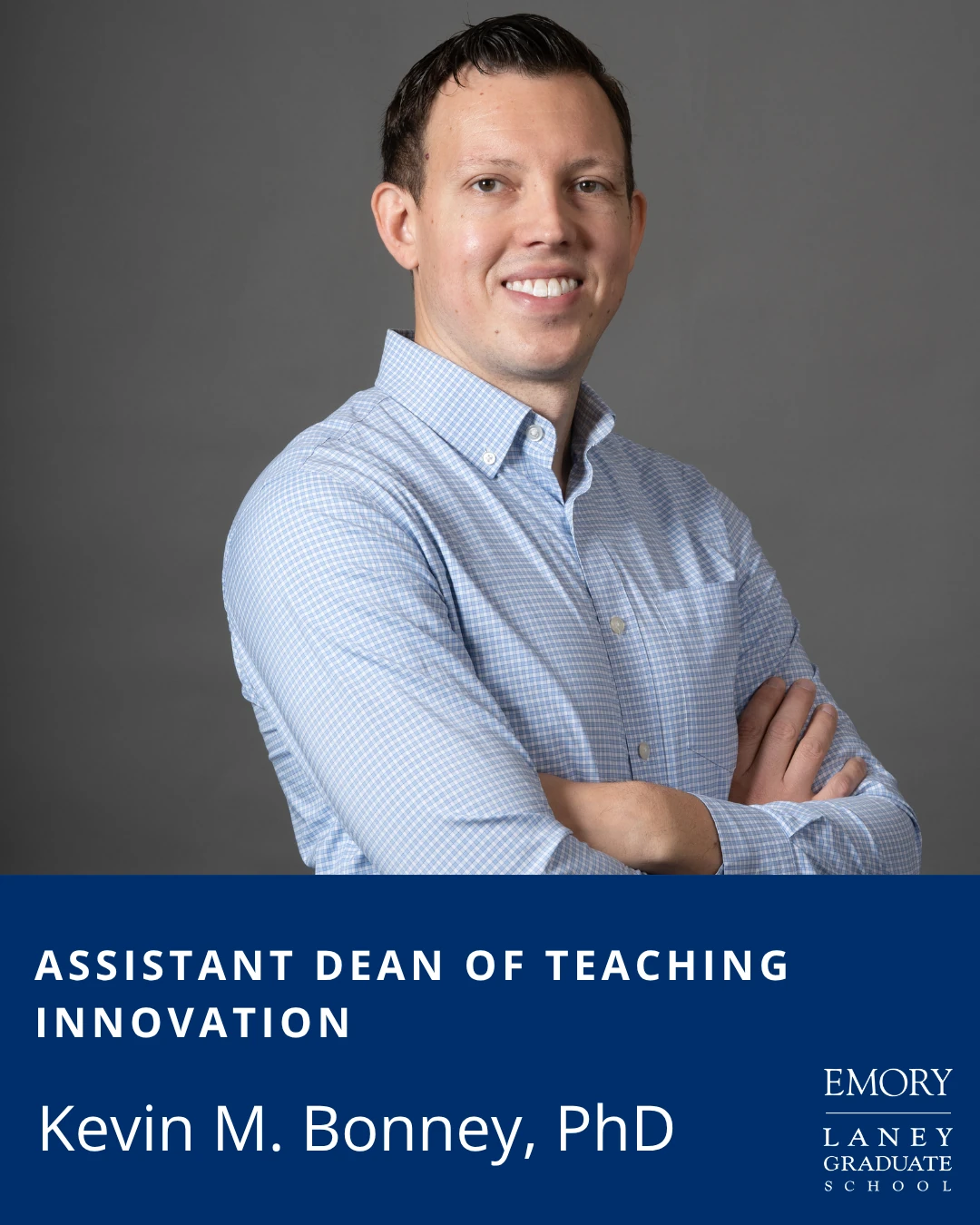
Laney Graduate School welcomes Kevin M. Bonney, PhD, as Assistant Dean of Teaching Innovation, bringing expertise in evidence-based teaching, faculty support, and dynamic, learner-centered pedagogy.
The Laney Graduate School is pleased to welcome Kevin M. Bonney, PhD as the new Assistant Dean of Teaching Innovation, effective July 1, 2025. A scientist, educator, and nationally recognized leader in evidence-based pedagogy, Bonney has a record of advancing learner-centered, inclusive, and innovative teaching in higher education.
In his new role, Bonney will lead efforts to strengthen teaching across the Graduate Division of Biological and Biomedical Sciences (GDBBS) by partnering closely with the LGS Academic Affairs team, GDBBS faculty, and instructional leaders throughout the division. His charge is both ambitious and essential: to cultivate dynamic teaching practices that reflect the latest research in graduate education and to support faculty and students in building strong pedagogical foundations.
“Teaching innovation,” Bonney explains, “is a learner-centered approach that leverages technological innovation to prepare students for success in their advanced studies and future careers.” At the heart of his philosophy is a deep commitment not only to how students learn, but to how faculty are supported as they take on the work of pedagogical transformation. “I’m excited to create new opportunities for collaboration, peer mentorship, and meaningful recognition of excellence in teaching,” he says.
Bonney comes to Emory from New York University, where he served as Assistant Dean of Faculty Development and Program Advancement in the Liberal Studies division. There, he led curriculum design initiatives, assessment reforms, and inclusive faculty development programming. His work has focused consistently on bridging rigorous research with practical tools that empower faculty in the classroom. A champion of active learning, he has helped faculty adopt flipped classroom models—an approach he describes as “transformational” for both students and instructors.
Flipped classroom teaching replaces traditional in-class lectures with interactive modules and videos completed in advance, allowing class time to be used for active learning, collaborative problem-solving, and real-time feedback. “Numerous reports have shown it to be highly engaging and effective,” Bonney says. “Many faculty I’ve mentored reported great success in better understanding and meeting the needs of their students.” His commitment runs deep: he even authored a textbook, Biology: Textbook and Activities for the Flipped Classroom, to support faculty using this model.
In addition to his role at Laney, Bonney will serve as Senior Director of Programs in the Office of the Dean of the School of Medicine and as Coordinator of Evaluation and Program Assessment for Education and Training at Winship Cancer Institute. His interdisciplinary experience and collaborative leadership will help strengthen connections across graduate, medical, and research training at Emory.
A microbiologist by training, Bonney earned his PhD in Microbiology and Immunology from Northwestern University. He has authored more than 30 peer-reviewed publications and delivered numerous invited talks and workshops on teaching excellence, faculty development, and pedagogical innovation.
When asked how he plans to support faculty in a diverse and research-intensive environment like Laney, Bonney emphasizes humility, partnership, and care. “My approach is to center the needs and perspectives of learners while honoring the often-unacknowledged labor that faculty dedicate to creating change,” he says. His goal is to provide the resources, training, and encouragement faculty need to experiment with new practices—and to celebrate their successes along the way.
As Bonney steps into this new chapter, Laney looks forward to advancing a culture of teaching excellence that empowers faculty and enhances the learning experience of graduate students across the sciences.